

 English
 Türkçe
 Русский
 العربية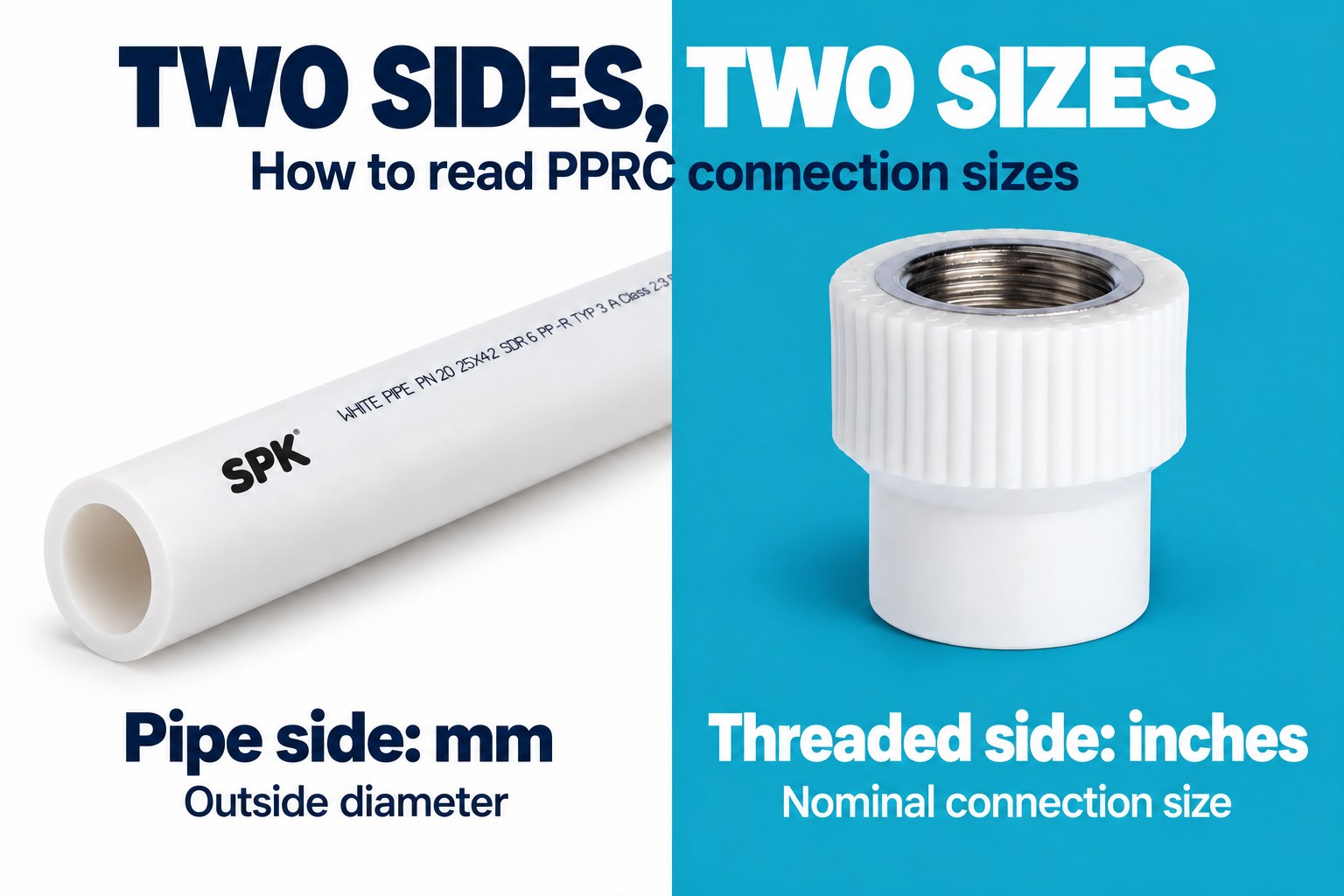
In common PPRC fitting size pairings, a nominal 1-inch connection is associated with a pipe outside diameter of 32 mm. Other familiar pairings are ½ inch with 20 mm, ¾ inch with 25 mm and 2 inches with 63 mm. These are connection size pairings, not mathematical conversions. As a unit of length, 1 inch is exactly 25.4 mm; the inch designation on a threaded fitting describes its nominal connection size.
Understanding this distinction makes pipe and fitting catalogues easier to read. This guide covers common pairings from ½ inch to 4 inches, explains what a pipe's millimetre size means and shows how to read both sides of a threaded transition fitting before ordering.
What do inches and millimetres mean for PPRC pipes?
Threaded connection sizes are commonly expressed in inches: ½ inch, 1 inch and 1½ inches are typical examples. Catalogues may use either the double-prime symbol or a double quotation mark: 1″ and 1" both indicate inches. When reading a fitting specification, distinguish this nominal connection size from the pipe's outside diameter.
For PPRC pipes, sizes such as 20, 25, 32 and 40 mm identify the outside diameter. A “32 mm PPRC pipe” therefore has a nominal outside diameter of 32 mm. This number does not directly describe the opening through which water flows.
A nominal size is a designation used to identify a product or connection. A threaded connection labelled 1 inch does not necessarily measure 25.4 mm across a surface you can reach with a measuring tool. Dividing a pipe's outside diameter by 25.4 is therefore not a reliable way to select a threaded fitting. Read the pipe-side millimetre size and the thread-side nominal inch size together.
Common PPRC pipe and threaded connection size pairings
The following table shows common pairings also found in SPK's threaded transition fitting catalogue. The millimetre column refers to the outside diameter of the PPRC pipe.
| Nominal inch connection size | Common PPRC pipe outside diameter pairing |
|---|---|
| ½″ | 20 mm |
| ¾″ | 25 mm |
| 1″ | 32 mm |
| 1¼″ | 40 mm |
| 1½″ | 50 mm |
| 2″ | 63 mm |
| 2½″ | 75 mm |
| 3″ | 90 mm |
| 4″ | 110 mm |
This is not a length conversion table. It also does not mean that each pipe diameter can be paired with only one thread size. Transition fittings are available in different combinations, so both connection sizes on the selected product must be checked when placing an order.
How do you read a size such as 32 × 1″ or 25 × ½″?
If a PPRC threaded transition fitting is listed as 32 × 1″, the first number identifies the side that connects to a PPRC pipe with a 32 mm outside diameter. The second number gives the threaded side's nominal 1-inch size. The “×” separates two connection sizes; it is not an instruction to multiply them.
SPK's catalogue also includes a 25 × ½″ option. Its plastic connection side is for a 25 mm pipe, while its threaded side has a nominal ½-inch connection. Similarly, 20 × ¾″ shows that pipe and thread sizes can be offered in combinations other than the common pairings in the table.
Knowing that a 25 mm pipe is commonly paired with a ¾-inch connection does not mean that every 25 mm adapter has a ¾-inch thread. Check the complete size, whether the thread is female or male, and the connection standard. When several options share the same pipe diameter, the product code helps distinguish the required fitting.
Why are outside diameter and inside diameter different?
A pipe's outside diameter is measured across its outer surfaces. The inside diameter describes the opening within the pipe. The pipe wall, or wall thickness, accounts for the difference.
Two pipes with the same outside diameter can have different inside diameters if their wall thicknesses differ. Two products described as 32 mm pipes should therefore not automatically be assumed to have the same internal opening. The general geometric relationship is inside diameter = outside diameter − 2 × wall thickness. Use the relevant product dimensions and tolerances when applying it.
For wall thicknesses and SDR series, see our PPRC pipe dimensions and wall thickness guide. An inch designation or outside diameter alone does not establish a pipe's pressure resistance or suitability for a particular project.
How should pipe and fitting sizes be checked?
Start with the marking on the pipe or the catalogue dimensions. If measuring the pipe, measure across the outside of its straight body. A measurement across the body of a socket, elbow or threaded metal insert cannot be used in place of the pipe's outside diameter.
Confirm these three details before selecting a fitting:
- Pipe side: the PPRC pipe's outside diameter in millimetres.
- Threaded side: the nominal inch size and female or male thread type, where applicable.
- Product identification: the complete fitting size, connection standard and product code.
For example, specifying a “1-inch female threaded connection for a 32 mm pipe” is clearer than simply requesting a “1-inch fitting”. Stating both sizes reduces uncertainty during selection and ordering.
Frequently asked questions
What is a 1-inch PPRC connection in millimetres?
In common PPRC connection pairings, a nominal 1-inch thread is associated with a pipe outside diameter of 32 mm. This is separate from the length conversion of 1 inch to 25.4 mm.
What is a 2-inch PPRC connection in millimetres?
The common pairing is a nominal 2-inch connection with a 63 mm outside diameter pipe. Always read the complete size of the selected transition fitting.
What inch sizes are commonly paired with 20 mm and 25 mm pipes?
A 20 mm outside diameter is commonly paired with ½ inch, and 25 mm with ¾ inch. Individual adapters may have different thread sizes depending on the product option.
What inch sizes are commonly paired with 40 mm and 50 mm pipes?
Common pairings are 40 mm with 1¼ inches and 50 mm with 1½ inches. These are connection pairings, not direct millimetre-to-inch conversions.
Where should a PPRC pipe be measured?
Measure across the outside of the pipe's straight body. Measuring the internal opening or the outside of a fitting gives a different dimension. Check the result against the product marking and catalogue.
Explore SPK PPR water supply systems for pipe and fitting options. When requesting product assistance or a quotation, provide the pipe outside diameter, any threaded connection size, operating conditions and required quantity.